Essential Website Maintenance Services for Malaysian Businesses
Website maintenance is usually bought as a monthly figure and almost never as a defined scope. That is the wrong way round: until you know which jobs are inside the retainer, the price tells you nothing.
This guide sets out what maintenance covers, using the official documentation behind each job — Let's Encrypt on certificate lifetimes, WordPress on what does and does not update itself, and Google on monitoring what search can crawl and how a page performs.
It deliberately does not quote monthly maintenance prices. Scope first, then cadence and service level, and only then a price you can compare.
What maintenance should mean in the contract
"Website maintenance" is sold as a monthly line item far more often than it is defined. Before comparing suppliers, agree what work is inside the scope.
A defensible maintenance scope for a Malaysian small business covers five distinct jobs, each with published guidance behind it: keeping the TLS certificate valid, keeping the platform and its extensions updated, monitoring what Google can crawl and index, watching for performance and accessibility regressions, and holding backups you have actually restored from.
The rest of this guide takes each one in turn and states what the official documentation says, so you can write the scope rather than accept somebody else's. Costs and yearly budgeting are a separate question — our guide to website maintenance costs in Malaysia covers the budgeting side.
Certificates: free, automated, and short-lived
The padlock in the address bar comes from a TLS certificate, and certificates expire. When one lapses, browsers show a full-page security warning instead of your site — the most abrupt outage a small business can suffer.
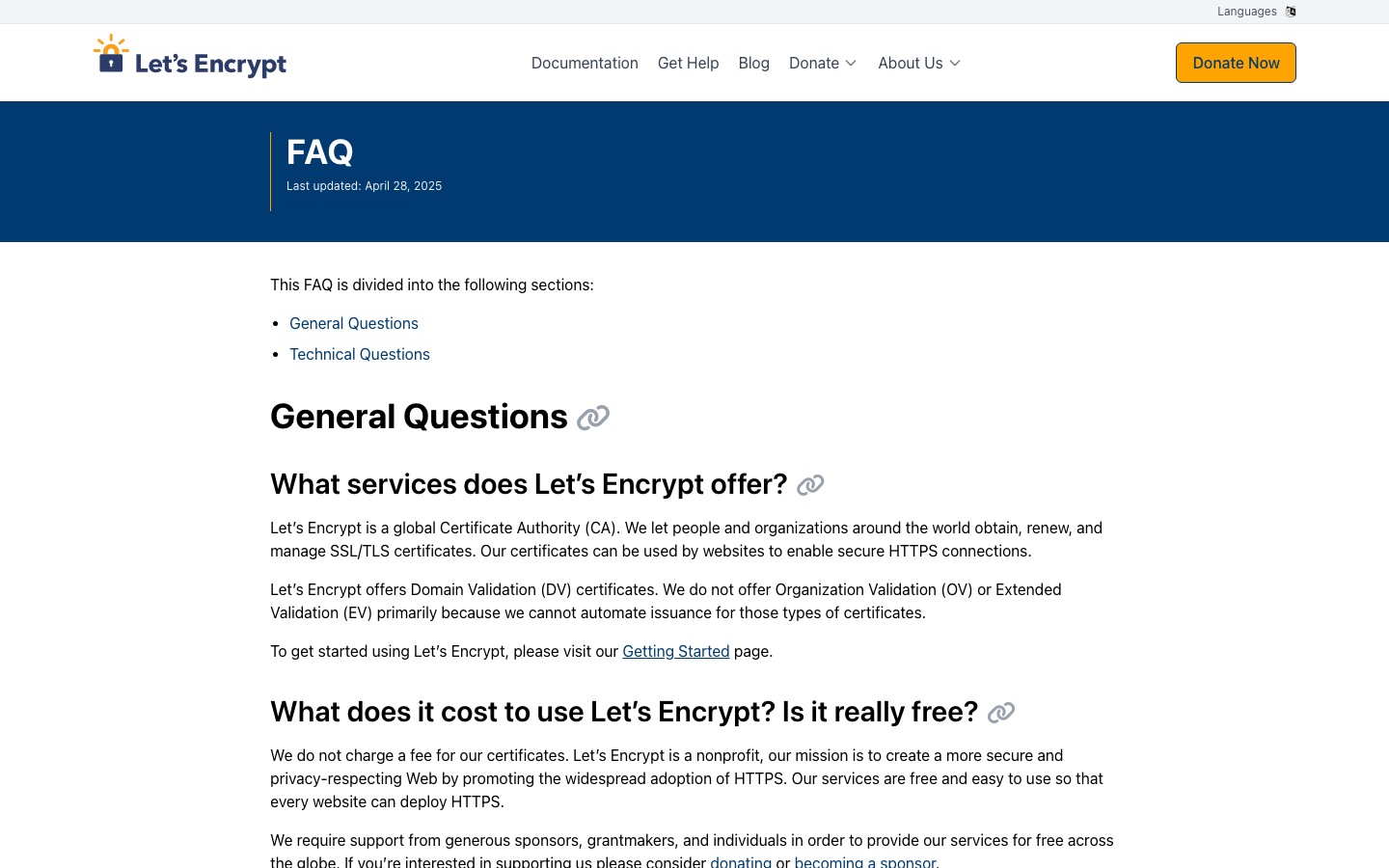
Let's Encrypt, which issues certificates for a very large share of the web, states that it does not charge a fee for them. It also states the lifetimes plainly: default certificates are valid for 90 days, and subscribers can opt in to short-lived certificates valid for six days. It recommends renewing 90-day certificates every 60 days and six-day certificates every three days, and notes there is no way to adjust those lifetimes.
That is the entire argument for automation. A 90-day cycle is far too short to manage from a calendar reminder, and a six-day cycle is impossible to. So the maintenance question is not "how much does the certificate cost" but "which system renews it, what happens when a renewal fails, and who is alerted". Get that answer in writing.
Sources: [1]
Platform and extension updates
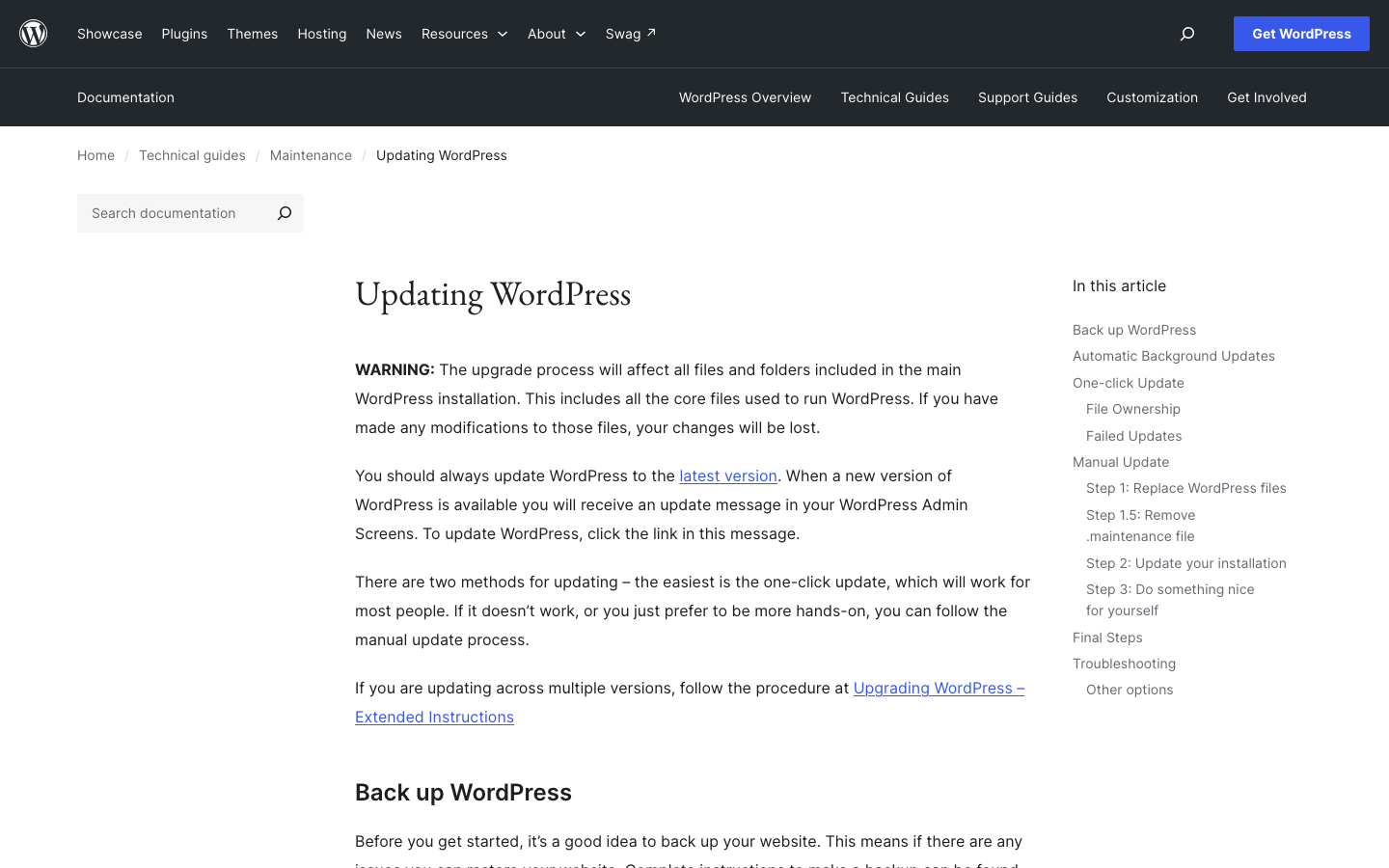
If your site runs on WordPress, the update behaviour is documented rather than a matter of opinion. WordPress states that since version 3.7, most sites apply minor and security updates automatically in the background, while major feature releases still require someone to click Update. It also warns that the upgrade process affects all files and folders in the main installation, so modifications made directly to core files are lost, and it advises backing up the site before starting.
That produces three concrete maintenance duties. First, someone must be responsible for major-version updates, because those do not happen on their own. Second, plugins and themes need the same attention, and they are where most sites accumulate risk. Third, a backup must exist before every update, not after it.
If your site is on a different platform, the same three questions apply: what updates itself, what needs a human, and what is backed up before the change.
Sources: [2]
Monitoring what Google can see
A site can be online and still be invisible. Search Console is the free tool that tells you the difference, and Google documents how to use it.
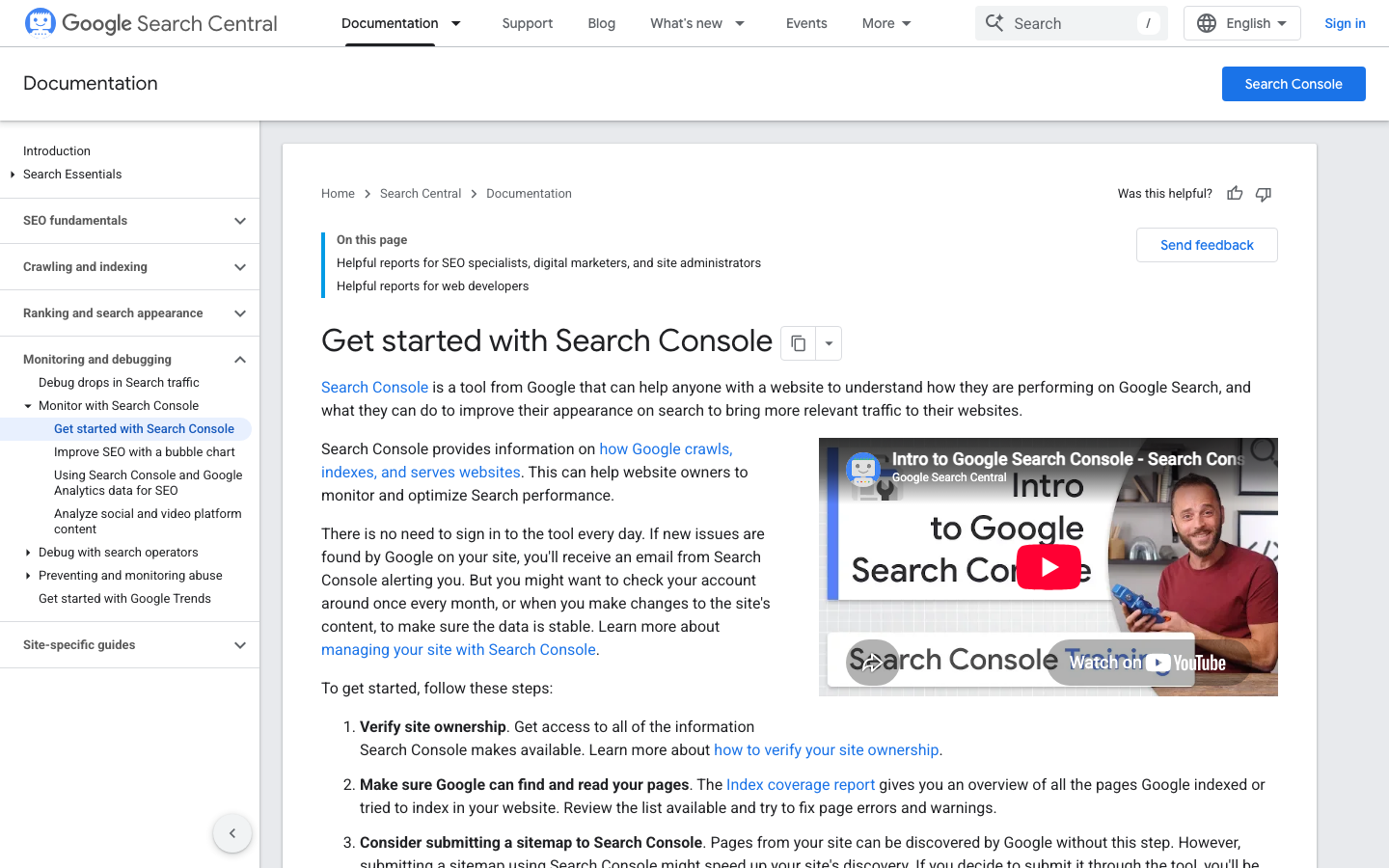
Getting started requires verifying site ownership. Once verified, the index coverage report shows the pages Google has indexed or tried to index and the errors it hit, and you can submit a sitemap so new pages are discovered faster. Google notes there is no need to sign in daily — it says you will receive an email alert when new issues are found, and suggests checking your account around once a month, or when you change the site's content.
For a maintenance agreement, that translates into a defined deliverable: ownership verified in an account your business controls, the sitemap submitted, alerts routed to a monitored mailbox, and a monthly look at coverage. Two of those are one-off setup; the rest is the recurring work you are paying for.
Sources: [3]
Catching performance and accessibility regressions
Sites do not usually get slower in one dramatic step. They drift — a new tracking script, an unoptimised image uploaded by a staff member, a plugin that adds a font.
Google publishes measurable targets to drift against: Largest Contentful Paint within the first 2.5 seconds, Interaction to Next Paint under 200 milliseconds, and a Cumulative Layout Shift score under 0.1. Recording those three numbers for a fixed set of pages on a fixed cadence turns a vague "the site feels slower" into a comparison against last month.
Accessibility drifts the same way, and W3C's WCAG 2.2 principles — perceivable, operable, understandable, robust — give the recheck a defined scope. The practical recurring test is small: confirm the enquiry form can still be completed with a keyboard alone, that labels and focus states survived the last theme update, and that newly uploaded images still carry alternative text.
Cadence, service levels and handover
Once the work is defined, three commercial terms decide whether the agreement is worth anything.
Cadence. State what happens weekly, monthly and quarterly. Certificate renewal is automated and continuous. Plugin and platform updates are typically monthly, with security releases handled as they appear. Search Console coverage and performance readings fit a monthly rhythm, matching Google's own suggestion of checking around once a month or after a change.
Service level. Define what counts as an outage, how it is reported, the response time you are buying, and what falls outside the retainer. "Support included" without a response path is not a service level.
Handover. Your business should own the domain, hosting, source code, backups, analytics and Search Console. Ask for a written statement of where backups are stored, how long they are retained, and when one was last restored — an untested backup is an assumption, not a safeguard. Ask also what you would receive on the day the agreement ends.
What a maintenance retainer should cover, and the guidance behind each item
| Maintenance job | Published guidance | Typical cadence | Question to ask your supplier |
|---|---|---|---|
| TLS certificate renewal | Let's Encrypt: no fee; 90-day default validity, six-day option; renew at 60 days or three days | Automated and continuous | Which system renews it, and who is alerted if a renewal fails? |
| Platform updates | WordPress: minor and security updates automatic since 3.7; major releases need a manual update | Monthly, plus security releases as they appear | Who is responsible for major-version updates? |
| Plugin and theme updates | WordPress: the upgrade process overwrites core files; back up first | Monthly | Is a backup taken before every update? |
| Search visibility monitoring | Search Console: verify ownership, index coverage report, sitemap, issue alerts | Monthly, or after a site change | Is ownership verified in an account we control? |
| Performance regressions | Core Web Vitals: LCP 2.5s, INP 200ms, CLS 0.1 | Monthly, on a fixed set of pages | Which pages are measured, and are the readings reported to us? |
| Accessibility regressions | WCAG 2.2: perceivable, operable, understandable, robust | Quarterly, and after any theme change | Is the enquiry form retested with a keyboard alone? |
| Backups | WordPress: back up before updating so the site can be restored | Continuous, with periodic restore tests | Where are backups kept, for how long, and when was one last restored? |
Questions to settle before signing a maintenance agreement
- Which system renews the TLS certificate, and who is alerted when a renewal fails?
- Who applies major platform updates, as distinct from automatic security updates?
- Is a backup taken before every update, and where is it stored?
- When was a backup last restored as a test, rather than merely taken?
- Is Search Console ownership verified in an account your business controls?
- Where do Search Console issue alerts get delivered, and who reads them?
- Which pages are measured for LCP, INP and CLS, and how often?
- How often is the enquiry form retested for keyboard operation and labelling?
- What is the response path and response time when the site goes down?
- What is explicitly excluded from the retainer and charged separately?
- What do you receive on the day the agreement ends?
FAQ
Does an SSL certificate need to be renewed manually?
It should not be. Let's Encrypt states that its certificates carry no fee, that default certificates are valid for 90 days and a six-day short-lived option exists, and that it recommends renewing at 60 days and three days respectively. It also states there is no way to adjust those lifetimes. Cycles that short have to be automated, so the maintenance question is which system renews the certificate and who is alerted if a renewal fails.
Does WordPress not update itself already?
Partly. WordPress documents that since version 3.7 most sites apply minor and security updates automatically in the background, but major feature releases still require someone to click Update. It also warns that the upgrade process affects all files in the main installation and advises backing up first. Plugins and themes need the same attention, which is where most of the recurring work sits.
What monitoring should be included in maintenance?
At minimum, Google Search Console. Google documents verifying site ownership, using the index coverage report to see what was indexed or failed to index, and submitting a sitemap. It notes you will receive an email alert when new issues are found and suggests checking around once a month or after you change the site. Ownership must be verified in an account your business controls, not your supplier's.
How is maintenance different from a website redesign?
Maintenance keeps a working site working: certificates, updates, backups, monitoring and regression checks against published targets such as Core Web Vitals and WCAG 2.2. A redesign changes what the site is. If your monthly readings show the site drifting outside those targets and the cause is structural rather than a single script or image, that is the point at which the conversation becomes a redesign rather than maintenance.
Key takeaways
- Define the scope before comparing prices: certificates, updates, monitoring, regression checks, backups and handover.
- Let's Encrypt certificates are free but valid for 90 days by default, with a six-day option — renewal must be automated.
- WordPress applies minor and security updates automatically since 3.7, but major releases and plugins still need a person.
- Search Console ownership must be verified in an account your business controls, with issue alerts going to a monitored mailbox.
- Track LCP, INP and CLS monthly on a fixed set of pages so performance drift shows up as a comparison, not a feeling.
- An untested backup is an assumption; ask when one was last restored.
Sources and image provenance
- Let's Encrypt Frequently Asked Questions — Internet Security Research Group (Let's Encrypt). Checked 1 September 2026 (HTTP 200). Primary source.Evidence used: Let's Encrypt states that it charges no fee for certificates, that default certificates are valid for 90 days, that a six-day short-lived option exists, and that it recommends renewing 90-day certificates every 60 days and six-day certificates every three days.
- Updating WordPress — WordPress.org. Checked 1 September 2026 (HTTP 200). Primary source.Evidence used: WordPress documents that since version 3.7 most sites apply minor and security updates automatically in the background, that major feature releases still require a manual update, and that a backup should be taken before updating.
- Get started with Search Console — Google Search Central. Checked 1 September 2026 (HTTP 200). Primary source.Evidence used: Google documents verifying site ownership, the index coverage report, submitting a sitemap, and email alerts when new issues are found, and describes checking roughly monthly or after site changes.
- Understanding Core Web Vitals and Google search results — Google Search Central. Checked 1 September 2026 (HTTP 200). Primary source.Evidence used: Google publishes the good-experience targets used here: LCP within 2.5 seconds, INP under 200 milliseconds and CLS under 0.1.
- WCAG 2 Overview — W3C Web Accessibility Initiative. Checked 1 September 2026 (HTTP 200). Primary source.Evidence used: W3C publishes WCAG 2.2 and its perceivable, operable, understandable and robust principles, which give recurring accessibility regression checks a defined scope.
Image provenance
- Screenshot of letsencrypt.org captured 1 September 2026 — captured 1 September 2026 via Playwright Chromium screenshot of the resolved source URL at a 1440x900 viewport. Screenshot of a publicly accessible official page, reproduced for citation and commentary; Kreativ Studio claims no ownership of the depicted page, brand or content. Depicted content: Internet Security Research Group (Let's Encrypt) and its respective rights holders. Review: Screenshot captured and visually inspected by the Kreativ Studio editorial team on 1 September 2026. SHA-256:
7a1a5c6adce0d09aa868140fcc872dea15e54f46ef308ffb75d7243f504a79ba - Screenshot of wordpress.org captured 1 September 2026 — captured 1 September 2026 via Playwright Chromium screenshot of the resolved source URL at a 1440x900 viewport. Screenshot of a publicly accessible official page, reproduced for citation and commentary; Kreativ Studio claims no ownership of the depicted page, brand or content. Depicted content: WordPress.org and its respective rights holders. Review: Screenshot captured and visually inspected by the Kreativ Studio editorial team on 1 September 2026. SHA-256:
a2187e7cfb7751bcf3698c4c13b0b06ddcb1058b444871b0461b50f7fa0a641a - Screenshot of developers.google.com captured 1 September 2026 — captured 1 September 2026 via Playwright Chromium screenshot of the resolved source URL at a 1440x900 viewport. Screenshot of a publicly accessible official page, reproduced for citation and commentary; Kreativ Studio claims no ownership of the depicted page, brand or content. Depicted content: Google LLC and its respective rights holders. Review: Screenshot captured and visually inspected by the Kreativ Studio editorial team on 1 September 2026. SHA-256:
fcc18cdbe8f2145f58f3e8b6e3a8e5eefcce95ce5efa69fdf88a251e66a35f0b
This guide covers what maintenance services include. It deliberately quotes no monthly maintenance price, because no cited source publishes one.